The Centers for Disease Control and Prevention’s new video highlights everyday actions nursing home residents and staff can take to prevent infections in their community. Keeping hands and surfaces clean, staying away from others if you are sick, wearing a mask when sick, and telling others if you don’t feel well are simple but important actions to reduce the spread of germs throughout a nursing home community. Residents and staff play a vital role in keeping nursing home communities safe and healthy.
Substance Use Disorder Treatment and Access Policy and Procedure Toolkit for Nursing Homes and Adult Care Facilities
The Substance Use Disorder Treatment (SUD) and Access Policy and Procedure Toolkit for Nursing Homes and Adult Care Facilities is intended to provide easy-to-adapt policies and procedures for facilities that wish to implement or improve their care for residents with SUD, which includes access to behavioral health resources, medications, telehealth, and referral networks. Most of the policies deal with opioid use disorder treatment, as this was the overarching need identified by nursing homes and adult care facilities; however, this toolkit was designed to be modified, and future updates will include additional substance use disorder policies.
Suicide Prevention Awareness Month
Emergency Departments:
Outpatient Clinical Practices
- Zero Suicide: Toolkit
- Zero Suicide: Resources for Integrated Primary Care and Behavioral Health Settings
- Zero Suicide Institute: Assessing and Managing Suicide Risk (AMSR) Training
- Suicide Prevention Resource Center: Resources for Clinical Practice
- Suicide Prevention Resource Center: Suicide Prevention Toolkit for Primary Care Practices
- National Action Alliance for Suicide Prevention: Recommended Standard Care for People with Suicide Risk: Making Health Care Suicide Safe
- Center for Accelerating Practices to End Suicide: Resources for Clinician
Nursing Homes
- Zero Suicide Institute: Assessing and Managing Suicide Risk (AMSR) Training
- Substance Abuse and Mental Health Services Administration: Promoting Emotional Health and Preventing Suicide: A Toolkit for Senior Living Communities (SPARK Kit)
- Center for Excellence in Behavioral Health Care in Nursing Facilities: Mental Health 101, Suicide Prevention & De-escalation Strategies
- Suicide Prevention Resource Center: Resources for Clinical Practice
Validated Screening Tools and Assessments
Safety Planning
-
Suicide Prevention Resource Center: Suicide Care Management Plans
Reimbursement and Resources for Screening and Supporting Patients with a Substance Use Disorder
The Northeast (Region 1) Mid-Atlantic (Region 2) CMS QIN-QIOs’ Reimbursement and Resources for Screening and Supporting Patients with a Substance Use Disorder tool helps healthcare teams determine appropriate use of clinical screening assessment tools such as the DAST-10 for patient self-reporting, or more in-depth assessments, including SBIRT and TAPS, for identifying patients most susceptible to substance use disorder (SUD). It provides information for identifying and locating referral sources to help connect patients and their families and care partners to treatment services and community support systems. It also provides information on appropriate SUD billing codes for reimbursement, including the CMS monthly bundle of services for the treatment of opioid use disorders or other SUDs.
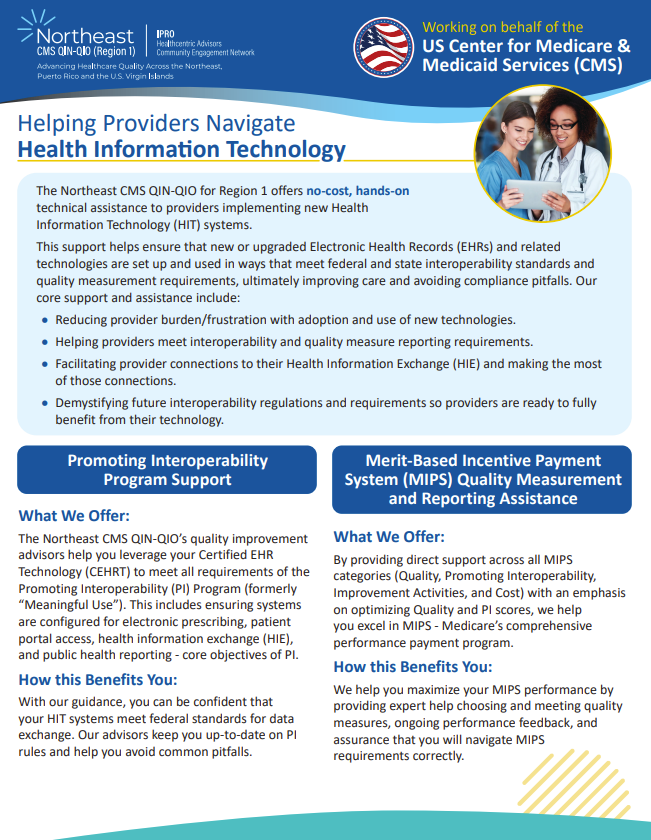
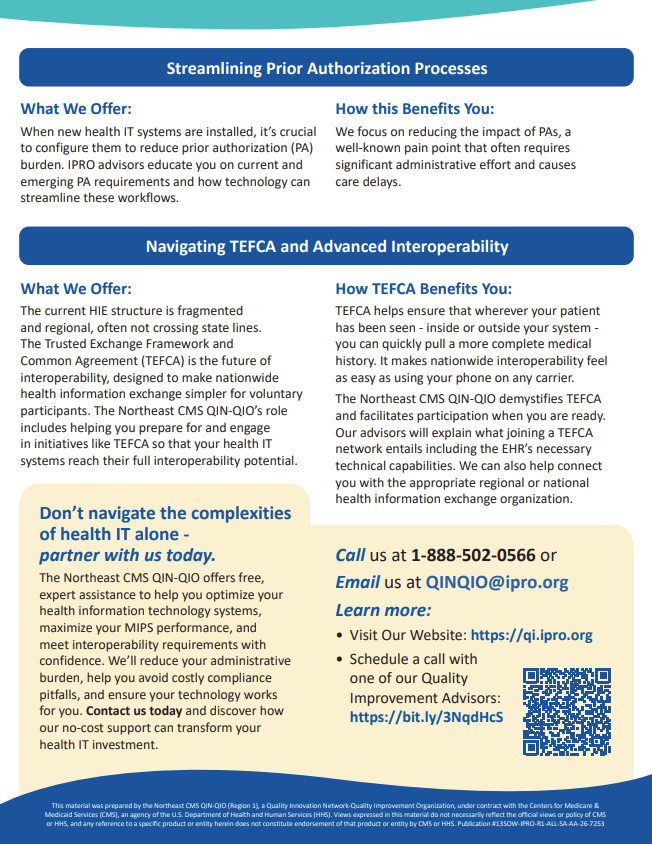
Helping Providers Navigate Health Information Technology
Sepsis Prevention Assessment Tool for Nursing Homes
Nursing home residents are at risk of developing infections that can lead to sepsis, which is a medical emergency requiring immediate attention to prevent severe morbidity and mortality. The Sepsis Prevention Assessment Tool (SPAT) for Nursing Homes identifies gaps in sepsis policies, training, and practices in nursing homes that can be targeted to improve infection prevention, sepsis recognition, and health outcomes.
CDC is available to provide technical assistance to facilities and public health partners implementing this resource.
Tips and Instructions for Use (compliments QAPI Topic Tracking and Summary Document)
This resource provides guidance on using the QAPI Tracking and Summary Document to organize, document, and monitor quality improvement initiatives and performance improvement plans (PIPs) in nursing homes.
Nursing Home Naloxone Policy and Procedure Toolkit
According to a CMS memo regarding Mental Health/Substance Use Disorder (SUD), CMS has identified a need to improve guidance related to meeting the unique health needs of residents with mental health diagnoses and SUD. CMS clarified that when facilities care for residents with these conditions, policies and practices must not conflict with resident rights or other requirements of participation. They further clarified that facility staff should have knowledge of signs and symptoms of possible substance use, and are prepared to address emergencies (e.g., an overdose) by increasing monitoring, administering naloxone, initiating cardiopulmonary resuscitation (CPR) as appropriate, and contacting emergency medical services.[1] This naloxone nursing home toolkit is intended to provide easy to adapt policies and procedures for nursing homes that need to implement or improve their emergency response to opioid overdose, which includes naloxone administration.
[1] Revised Long-Term Care Surveyor Guidance | CMS. www.cms.gov. Accessed January 17, 2023. (https://www.cms.gov/medicareprovider-enrollment-and-certificationsurveycertificationgeninfopolicy-and-memos-states-and/revised-long-term-care-surveyor-guidance)
The Nursing Home Naloxone Policy & Procedure Toolkit PowerPoint
This is another resource, designed to be used as an introductory presentation. This slide deck contains an abridged version of the Toolkit and provides a general overview of the Toolkit contents. It includes select references to regulatory guidance, background, need assessment, features, and brief descriptions of the policies, procedures, and resources contained in the Toolkit.
Nursing Home Naloxone Policy & Procedure Toolkit Implementation Checklist
This resource was created to help facilities implement the Nursing Home Naloxone Policy & Procedure Toolkit. This checklist provides an overview for a process to successfully implement select toolkit contents.
MDS 3.0 Quality Measures
This manual is designed to assist organizations in identifying how a resident will “trigger” for a quality measure based on quality measure specifications and the coding of the MDS 3.0 Resident Assessment Instrument (RAI).
Advancing Anticoagulation Stewardship: A Playbook
The AC Forum, in partnership with FDA, identified seven Core Elements for improving systemic management of anticoagulants. The Playbook, developed with input from more than 30 experts, offers detailed strategies for each Core Element and is designed to be used by organizations establishing or considering Anticoagulation Stewardship programs, as well as those with existing programs in place. While all seven elements are important for implementation of a stewardship initiative, the first Core Element—securing the commitment of administrative leadership—is a foundational priority to ensure success and sustainability.
American Geriatrics Society Updated Beers Criteria for Potentially Inappropriate Medication Use in Older Adults
Link to American Geriatrics Society Updated Beers Criteria.
Note: This is a link to an external website and may require Society membership to access this content.
MARQUIS Medication Reconciliation for Hospitalists Toolkit from the Society of Hospital Medicine
Safer Medication Management for Better Transition of Care
SHM recognizes the importance of equipping hospital clinicians with evidence-based strategies to prescribe, document, and reconcile medications accurately and safely at times of care transitions.
Medication reconciliation, or med rec, is the process of compiling the most accurate list of medications a patient is taking to avoid dosing or other errors.
Take responsibility for med rec with your patients by:
Leading, coordinating or participating in med rec quality improvement efforts that incorporate best practices to improve patient outcomes.
Grasping key evidence-based interventions, such as obtaining the best possible medication history and effective discharge medication counseling.
Identifying patients who are at high risk for medication discrepancies due to the number and/or types of medications they are prescribed
Nursing Home Emergency Preparedness Checklist Resource
This checklist helps nursing homes develop, assess, and annually review their emergency preparedness plans. Based on CMS State Operations Manual Appendix Z, it provides a framework for identifying gaps and ensuring key emergency preparedness requirements are addressed.
Focus on Process Reliability
A quality improvement tool for determining the reliability of a process by assessing the 5 attributes.
Monthly Pressure Ulcer Tracking Form and Guide
The Monthly Pressure Ulcer Tracking Form was developed to assist facilities track their pressure ulcers on a monthly basis with the ability to carry over unhealed/unresolved pressure ulcers unto a new monthly tracking form. It maintains an active list of all current pressure ulcers in real time to assist with the investigation, treatment and provide an important piece in the development of a targeted pressure ulcer prevention program. (See instructions below on how to download the tracking form.)
Complete this form to receive a link to download a zipped folder of the Pressure Ulcer Tracking Resources to include the Excel tracking form as well as a PDF instructional guide that explains the use of the tool.
For questions on the Monthly Pressure Ulcer Tracking Form and Guide, please contact QINQIO@ipro.org.